A TRIBUTE THAT FELT DIFFERENT FROM EVERYTHING ELSE THAT NIGHT
The stage had been transformed into something unusually simple.
White flowers surrounded the musicians. Candles flickered along the edges of the platform.
Behind them, images from Dolly’s extraordinary career slowly appeared — the rhinestones, the enormous smile, the blonde hair, the guitars, the packed arenas.
Then the first notes began.
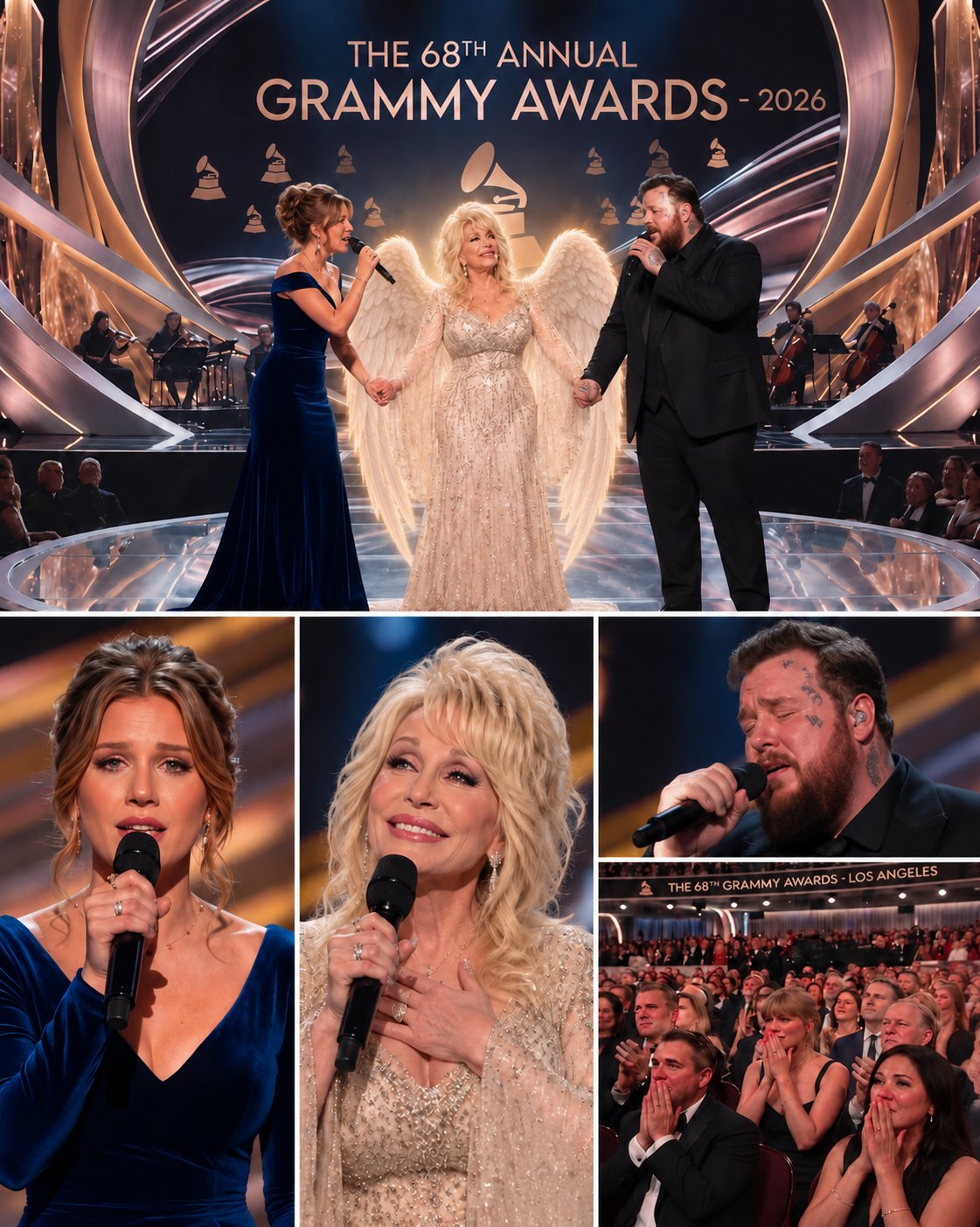
Hannah Harper and Jelly Roll stood on opposite sides of the stage, both visibly emotional.
Neither rushed to sing.
For a few seconds, they simply looked toward the glowing image of Dolly behind them.
Then Hannah began the first verse.
Her voice was soft and almost fragile.
Jelly Roll joined moments later, bringing a rougher, deeper tone that made the contrast between their voices unexpectedly powerful.
Within seconds, the room was completely still.
THEN DOLLY APPEARED BETWEEN THEM
The emotional centerpiece of the fictional tribute came when Dolly’s image appeared between the two singers.
Not as though she had returned to perform.
Not as though the moment was trying to pretend she was still there.
Instead, the visual was designed as a remembrance.
Dolly appeared in a sparkling white gown, surrounded by warm golden light, with delicate angel wings behind her.
The symbolism was impossible to miss.
For fans who had spent decades watching Dolly command stages around the world, seeing her positioned at the center of one more Grammy moment felt almost unbearably emotional.
She was no longer the performer.
She was the reason everyone else was singing.
THE AUDIENCE COULDN’T HOLD BACK
Cameras moved through the audience as the duet continued.
Some people bowed their heads.
Others wiped away tears.
Several artists could be seen singing quietly along.
There was none of the usual awards-show distraction.
No one appeared to be checking phones.
No one seemed interested in who was sitting beside whom.
For a few minutes, the compeтιтion disappeared.
The Grammys became a memorial.
And Dolly Parton became the one name that united the entire room.
JELLY ROLL’S VOICE CRACKED
As the song reached its final section, Jelly Roll appeared to struggle to keep his voice steady.
He paused briefly, looked toward Dolly’s image, and continued.
That tiny moment of vulnerability may have been more powerful than any perfectly delivered note.
This was not supposed to sound polished.
It was supposed to feel real.
Hannah reached toward him as they moved into the final chorus.
The orchestra grew louder.
Behind them, the screen filled with pH๏τographs from different chapters of Dolly’s life.
Young Dolly.
Hollywood Dolly.
Dollywood Dolly.
The songwriter.
The philanthropist.
The woman who could walk into a room covered in rhinestones and somehow make everyone else feel comfortable.
ONE FINAL IMAGE CHANGED EVERYTHING
Then the music slowed.
The pH๏τographs disappeared.
Only one image remained.
Dolly smiling.
No elaborate montage.
No long message.
Just that unmistakable smile filling the enormous screen.
The two singers lowered their microphones.
For a moment, nobody knew whether to applaud.
The silence lasted only a few seconds, but it felt much longer.
Then the crowd rose.
One row at a time.
Within seconds, nearly the entire room was standing.
The applause grew louder and louder.
But there was no celebration in it.
It sounded more like graтιтude.
WHY DOLLY STILL MEANS SO MUCH
There are successful entertainers.
There are superstars.
And then there are the rare people who become part of how a country remembers itself.
Dolly Parton belonged to that final category.
Her songs were never simply songs.
“Jolene” became a cultural phenomenon.
“9 to 5” became an anthem.
“I Will Always Love You” crossed generations, genres, and borders.
But Dolly’s influence extended far beyond music.
She became ᴀssociated with generosity, humor, literacy, resilience, and an almost stubborn refusal to become cynical.
She could laugh at herself before anyone else had the chance.
She could talk about growing up poor without pretending hardship was romantic.
And she could become enormously wealthy without losing the ability to speak to people who had very little.
That contradiction made her extraordinary.
She was larger than life without ever seeming completely removed from ordinary life.
IT WASN’T ABOUT PERFECT VOCALS
Perhaps that is why the fictional Grammy tribute worked so well.
It did not try to outshine Dolly.
That would have been impossible.
Instead, it tried to leave space for memory.
The shaky breaths.
The pauses.
The tears.
The moments when the performers seemed almost unable to continue.
Those imperfections made the performance feel more appropriate.
Because grief is not polished.
Love is not always polished either.
Sometimes the most meaningful tribute is simply trying to finish the song.
A FINAL THANK-YOU FROM THE MUSIC WORLD
As the applause continued, the lights around Dolly’s image slowly faded.
The angel-wing silhouette remained visible for just a few seconds longer.
Then it disappeared too.
No encore followed.
No presenter rushed immediately onto the stage.
The room was allowed to sit with the moment.
And perhaps that was the perfect ending.
Dolly Parton spent her life giving audiences songs for almost every emotion imaginable.
Love.
Heartbreak.
Work.
Faith.
Loneliness.
Hope.
Goodbye.
At this fictional Grammy tribute, the music industry finally had the chance to give one song back.
Not as another performance.
Not as another awards-show spectacle.
But as one enormous, trembling thank-you.
And when the final light disappeared from the stage, the message seemed clear:
The voice may be gone, but the songs — and the love behind them — are nowhere near finished.